

-
EVENT | Code3 and JIN Contribute to the AI Policy Conference at the Senate
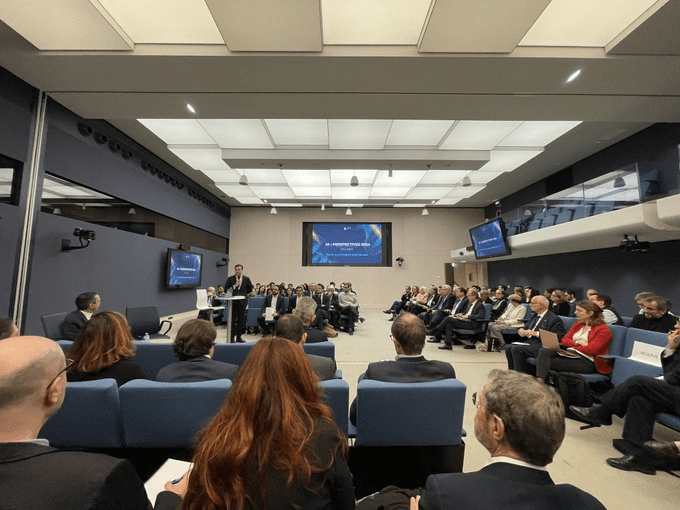
With the support of the Républicains team at the Senate, Edouard Fillias and Thomas Kurkidjian played a crucial role in organizing a significant one-day conference on AI at the Senate on December 7, 2003. Joined by top experts in the field, including Joëlle Barral, Director of AI Research at Google, philosopher of science Etienne Klein, Antoine Bordes (Helsing), Eric Trappier (Dassault Aviation), William Eldin (XXII), and Alice Pannier (IFRI), the event facilitated an in-depth assessment of the challenges related to artificial intelligence.
Confronted with a technology advancing at the speed of light and poised to reshape our lives in the fields of health, education, and defense, ethical and regulatory questions naturally arise. Indeed, AI represents a shift in the nature of human activity, not just its degree. It emerges as a political revolution, expanding the realm of freedom by granting new powers while raising concerns about unprecedented controls and the ability to anticipate our actions.
AI opens the door to equality by providing literal access to knowledge for all, yet it poses the risk of widespread job loss. Moreover, while AI could become a universal lingua franca, bringing us closer to common reasoning, it could also alienate us by relegating us to artificial virtual worlds designed solely for control.
As the EU takes pride in pioneering global regulations, it is evident that by becoming active participants in technology, we will truly understand and leverage its benefits. This is a realm that political voluntarism cannot solely relinquish to the United States, and one that we, as French and European citizens, must fully embrace.
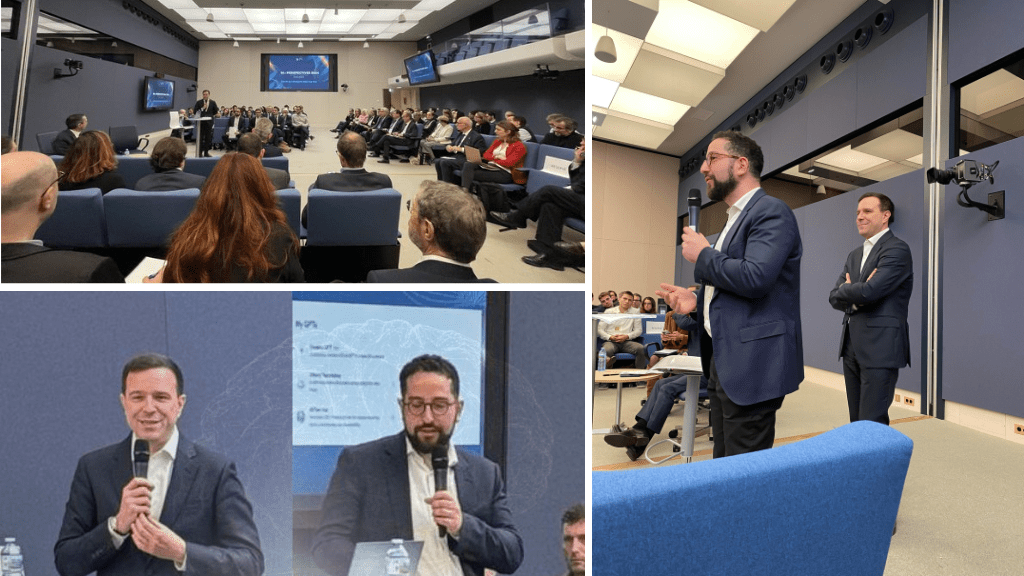
Edouard Fillias, Co-founder of JIN and President of Code3, and Eliott Maidenberg, Strategic Director and Head of the AI practice at JIN -
OP-ED | AI in politics: How can public debate be saved?
In six months’ time, the media will be taking their traditional stock of the past year, and looking ahead to the major challenges of the coming one. We already know what will be at the heart of this pivotal period between 2023 and 2024: the widespread use of generative artificial intelligence for the former, with the arrival of the famous ChatGPT and Midjourney, and the imminence of major elections in Europe and across the Atlantic for the latter. Between the two, a crucial question for our old democracies: what will AI-enhanced election campaigns look like?
The answer is already there: as soon as President Biden announced his candidacy for re-election, the Republican camp flooded the networks with true-to-life apocalyptic videos of migrants pouring in, soldiers occupying the streets and Taiwan being bombed. This clip, generated by artificial intelligence, provoked a great deal of emotion and comment – and rightly so – on the confusion between fiction and reality in an election campaign. In truth, this debate is one of the oldest in the world, since it concerns honesty or lies in politics. Voters didn’t wait for this type of content to cast doubt on everything that came from the other side, and give their uncritical support to everything that came from their own side.
No, the real game-changer with the advent of AI is the industrialisation of ultra-targeting of voters. As the Cambdrige Analytica scandal revealed, social networks had already made it possible to push messages tailored to each audience, via the aspiration of personal data. In a world where it is possible to generate virtually bespoke content for each user, we are in for a Cambridge Analytica on steroids. And in this new game, we all know that the extremes have an advantage because of the very nature of the human feelings they rely on to thrive. So how can we prepare? How do we deal with it?
There are three possible scenarios. The first is that of unbridled AI, without any form of regulation or brake. The result is a total cacophony, with voters harassed by an unprecedented amount of false information thrown around in far-fetched and crude scenarios. It’s a zero-sum game that adds to the weariness and disinterest in the democratic game, freezing it in place with existing trends and making it impossible for a new political offering to emerge.
The second is, of course, the need for strict regulations governing the use of AI in election campaigns, similar to those we have in France for electoral propaganda. We could define a pre-election period during which the use of AI is blocked, particularly by publishers, for all political content. A vast administrative and technical machine would be needed, for an uncertain result. Who would be legitimate in France to lead such a battle? The Commission nationale des comptes de campagne et des financements politiques (CNCCFP)? The Commission nationale de l’informatique et des libertés (CNIL)? The Council of State? And what about the European level, in the run-up to the 2024 elections?
The last option is that of self-limitation, by obtaining a commitment from all parties that they will not use AI in their electoral practices. It is not a question of relying on the goodwill and good faith of all the parties, but rather of making opacity on the subject politically costly. Why not imagine a charter, a manifesto signed by the entire political spectrum? Faced with the fear of seeing public debate poisoned by suspicion of AI, those who are absent would quickly lose out.
Ultimately, to preserve democracy, we need to invent a genuine safe place. A new digital agora that gives us oxygen, in the low-tech spirit that made the early Internet a space of infinite possibilities and riches. A kind of cyber sanctuary protected from the excesses of digital cacophony… And one that could find its counterpart in the physical world, since the theatre of democracy must remain the public space.Ultimately, if we are to preserve democracy, we will have to invent a genuine safe place. A new digital agora that gives us oxygen, in the low-tech spirit that made the early Internet a space of infinite possibilities and riches. A kind of cyber sanctuary protected from the excesses of digital cacophony… And one that could find its counterpart in the physical world, since the theatre of democracy must remain the public space. Right now, we need to rethink the use of public buildings in this new electoral context, to ensure that all areas of the country are able to take part in a complex, adversarial debate based on everyone’s arguments. The equivalent of the War Room concept, where information is used to understand the unfolding crisis, applied this time to public debate, in the service of informing citizens. It’s a conception of politics that goes against the grain of automatically generated content, automatically repeated by an automatically targeted profile.
-
OP-ED | Communication: silence for better understanding?

At the end of the performance, as the exhausted actors leave the stage, the grand theater of pension reform leaves us with the memory of a tiresome spectacle. From the first to the last act, the government declaimed the economic imperative – as much as moral – and invoked the deluge or forty-eight months of compulsory labor. The unions, in a united chorus, resisted to the strains of the Internationale for a social gain won by their elders. Finally, in the pit, the media cohort greedily sang the hymn of social conflict and its probable slide into general strike.
This distressing review, destined to be repeated, is just one example of this general inability to communicate calmly to solve our problems. Far from being the sole preserve of political representations, this “langue de bois” has infiltrated all our lives, personal and professional, turning them into drunken, absurd Kabuki theater. Juniors no longer understand seniors, tenants no longer talk to landlords, artists and their audiences curse each other out over a faux-pas, elected officials and their constituents shout at each other over the town planning scheme, and conflicts between ex-spouses are making separations ever more bitter. Who takes the time to listen when incantation and invective have become our lingua franca? This collective awkwardness in talking to each other is what we call the new incommunication.
But why is this situation of growing incommunication striking us when, paradoxically, we communicate abundantly, with agencies and language elements, powerpoints, polished e-mails and explanatory visuals? Everyone now has an unprecedented arsenal at their disposal to back up their words. Some will point to social networks, undoubtedly at the forefront of the charge for their propensity to play on our differences and amplify the false. Others will point to the change in our fragmented societies, shaken by crises of confidence.
It seems, however, that the evil is much deeper, rooted in the conception that has developed of communication itself: it is no longer a means of reaching out and rubbing shoulders with others, but a closed circuit, a closed door disqualifying those who don’t join the party of unilateral consensus. Perhaps we’re simply fascinated by our own words, our own message, without worrying about the answers. What if the obsessive, narcissistic narrative we serve up to ourselves in this deaf monologue is a form of reality that dispenses with the return of reality? In this climate of post-reality, where the real is manufactured, would the image we tell ourselves be enough to satisfy us?
In this way, communication, a vector for understanding others, is misused to become both armor and an active tool for vexing and excluding one’s interlocutor. The government’s insistence on “pedagogy” betrays this desire to educate this rebellious, gypsy-smoking people, rather than recognize the healthy, legitimate disagreements that structure it. It also reflects the obvious sense of superiority of those who know better. Thus, the contempt and smugness of messages circulating from a clumsy CAC40 CEO to the smallest condominium are so many discreet slaps in the face of those considered inferior. We protect ourselves from him, and to protect ourselves even better, we disqualify him. We knock him out of the story.
Incommunication is the refusal to consider the intelligence and otherness of one’s opponent, in order to justify speaking only to those who are convinced a priori. Contemporary magical thinking, it is a denial of reality in the face of the basic teachings of the Palo Alto School: communication is a pas de deux played out between sender and receiver.
Ultimately, incommunication is an admission of a certain insignificance, taking oneself as the sole reference point, like an immature child. These self-referential bubbles are like fortified castles, protecting us from fertile cleavage in favor of sterile conflict… And yet, “the spirit of the fortified castle is the drawbridge”, as René Char puts it! So how can we turn communication back into a gateway to the other and to the world? How do we get out of this bulletproof communication exercise that managers so avidly practice?
We propose a simple solution to this problem: sympathetic listening and empathy as the unsurpassed starting point for any kind of message. Rather than protecting or humiliating them, we propose to start by listening to this interlocutor, this colleague, this friend, this parent and this constituent. Breaking the cycle of incommunication means first and foremost re-establishing the functions of opinion research and analysis, this time of disinterested listening, without any pre-formatted language in mind, in order to grasp expectations and nuances, which tomorrow will be so many assets needed to combine logic and rally emotion.
We need to put aside, at least for a while, the recipes for persuasion and other magic potions of leadership. Let’s break away from the illusion that to exist you have to shine and win votes by the sheer force of your egotistical words. Like Jacques Pilhan of old, let’s rediscover the virtues of silence, moderation and a keen ear for the deep breaths of opinion. Surely positive influence begins here? That’s what we think with our JIN teams. To overcome incommunication, let’s start by listening and remaining silent, in all humility.
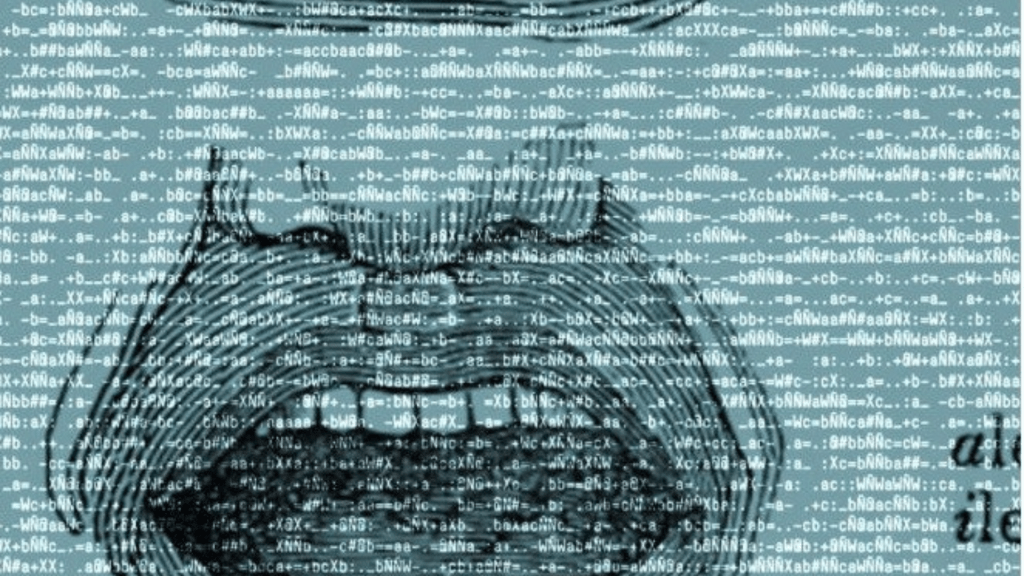
Image: Screaming to each other (by courtesy of Dall.E-2)
-
ARTICLE | AI and politics: In France, startups are indicating the market to follow
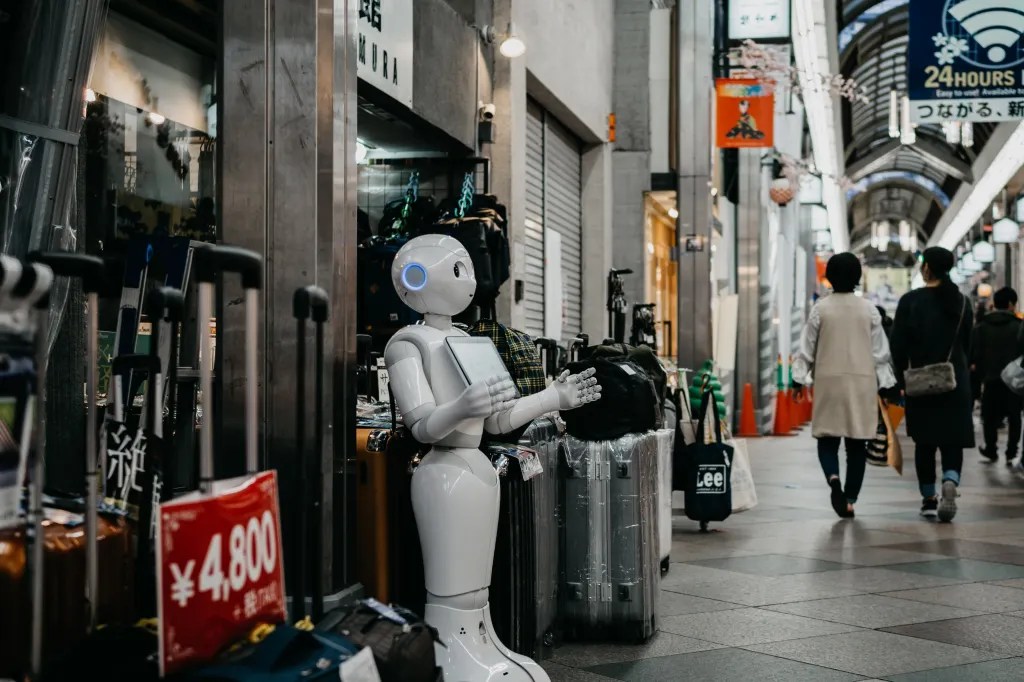
Article published in French in Libération.
590 French start-ups specialized in artificial intelligence (AI), including 76
that deal with generative AI – which creates new content – and not a single
one directly linked to politics. In its latest census, the digital industry
association France Digitale, a lobby for digital companies, identified
around twenty different sectors. But does this mean that there is no
market for AI in politics? “No, there is a market, but companies don’t
advertise politics as their primary customers. That’s not how they define
themselves,” observes Marianne Tordeux and Thomas Barreau at France
Digitale.“Generative AI will disrupt the world of communication and political
marketing by shortening the time to produce content and targeting more
precisely,” says Othmane Zrikem, Chief Data Officer and founder of an AI
company. The shift could happen quickly in the United States, where
political advertising spending reached $9.7 billion (8.86 billion euros) in2022, the year of the midterm elections, according to AdImpact. In fact,
the first official campaign video created by an AI was posted online on
April 25 by the Republican Party in response to Joe Biden’s candidacy
announcement. It describes a catastrophic scenario that begins with (fake) footage of the reelection of the Democratic president and continues with a fabricated sequence intended to illustrate the consequences of his reelection, from a financial crisis to China’s invasion of Taiwan.The road is still long
In France, the major disruption that AI could bring to political practice has
not yet occurred. “Everyone is in shock over generative AI, which is a
technological update that changes the game. Data analysis software claims
to use AI, which is true, but in reality, few completed things are being
commercialized. We will probably see players emerge by the end of the
year,” says Edouard Fillias, CEO of the consulting agency JIN.
Stephane Boisson also believes that there is still a long way to go. In
Montpellier, he heads Poligma, a company of eight employees that
aggregates, analyzes, and visualizes data, mainly public data, for political
candidates or municipalities. Data overlaps that can, for example, allow an
elected official to anticipate the need for childcare places in a
neighborhood or parking spaces reserved for people with disabilities. “AI
can do very interesting things, its algorithms can imagine scenarios, it can
become a decision aid without replacing elected officials. But for now, we
are still far from it,” he says. He is convinced that “the more relevant data
is aggregated, the better the results will be when running learning models.”He is not the only one with a company that exploits public data, the
quantities of which are increasing with the development of open data.
After working on around 1,500 electoral campaigns, including those of
Francois Hollande in 2012 and Emmanuel Macron in 2017, Arthur Muller,
Guillaume Liegey, and Vincent Pons stopped targeting elections with their
company LMP to focus on Explain, a company that markets an “AI
assistant” for companies responding to public orders.“Every propagandist’s dream”
Among the thirty or so clients they claim are Engie, Veolia, and Bouygues
Telecom. “This allows them to understand needs by analyzing thousands
of pages of administrative documents, municipal deliberations, and
reports, which contain a lot of information,” explains Guillaume Liegey.
“It’s at the intersection of two trends: the explosion of public data that a
human cannot handle by hand, and the maturity of LMMs, the large
language models, which allow for automatic reading and writing.” Theyclosed a 6 million euro funding round in April (to which Minister Jean-
Noël Barrot, a shareholder in LMP since 2020, did not participate this time, according to his office and the company).In the field of politics, it may not be for its commercial prospects that
generative AI will generate the most interest. “It will allow for much more
sophisticated and difficult-to-detect manipulation systems, on a much
larger scale than today, predicts Othmane Zrikem. More than private
companies, it will undoubtedly be state authorities, such as China, who
will be the first to use them for these purposes. It’s every propagandist’s
dream.” -
INTERVIEW | “Influencer marketing will be multiplied by 4 by 2025”

Interview published in French in Influencia
INfluencia: Can you describe your agency in a few words?
Edouard Fillias: JIN has been in existence for just over ten years and employs 120 people. Our objective is to understand communities and their respective ecosystems in order to activate them and provide a service to the brand managers who use our services. Our clients include Bouygues, Ferrero, Grand Optical, Allianz, Casino, Samsung and recently Happn. We have a very corporate and marketing culture.
IN: When did you get involved in influencer marketing?
E.F.: Very quickly. Our first client in this market was Europcar. We called on an Instagrameur who took a whole series of photos of the most beautiful roads in Europe. The idea of this project was not to take advantage of his community but to use his influence to spread this campaign in 20 countries. We then did influencer marketing campaigns for many other clients including Ricoh and Geodis. For Bouygues, we developed a BtoB operation using drone pilots to shoot images in tunnels. This sector has always fascinated me. In 2019, I even co-authored the Influencer’s Handbook published by Ellipses.
I apply the principle of Jacques Séguéla when he called on Dali for a Citroën ad.
IN: How has this sector evolved over the years?
E.F.: It all started with the emergence of bloggers in the early 2000s. These people who were good at writing were mostly journalists. From 2010 onwards, videographers like Squeezie began to appear. Since 2015, there has been an explosion of new online talent. With the collapse of the cost of access to video linked to the arrival of new smartphones, everyone is starting to post content on the web. It’s an incredible cultural revolution. Influencers are specialising in more and more specific niches. YouTube is and remains at the forefront of influencer marketing. I myself spend two hours a day on this platform because it is so rich.
IN: Faced with this explosion in the number of influencers, how does a brand choose one over another?
E.F.: Faced with the collapse of digital advertising, which is less and less impactful and effective, more and more clients are considering digital marketing as a recourse. While many agencies sell volume or pretend there is a wand to find the right influencers, I favour a more traditional approach that some might even say is old-fashioned. I apply the principle of Jacques Séguéla when he called on Dali for a Citroën ad. The designer and his messages must be in line with the brand. The meeting between the client and the influencer is a public relations job. It takes time and must be done face-to-face. The technological tools we use are used to detect talent, but in the end, the link must be forged between the creator and the company’s managers. This is even more true today because brands nowadays want to develop long-term relationships with the influencer, who becomes their muse, as it were. Most of them have become much more professional in recent years. Almost all of them have agents or agencies that represent them.
IN: Who are the most relevant influencers for a brand? The big global stars, the national stars or the nano-influencers?
E.F.: It all depends on the budget, the ambitions and the number of countries targeted by the client. We know that the larger an influencer’s community is, the less prescriptive they are. However, there is no universal answer to this problem. Global influencers can be counted on the fingers of one hand. To get high visibility quickly, using large national influencers is often the most effective option. To trigger a wave of buy-in from the bottom up, from customer to customer, using nano-influencers can make sense. Another option for brands would be to create their own influencer, but no one dares to do so yet and cross that Rubicon.
IN: How much does an influencer cost these days?
E.F.: We are currently going through a transition. 2021 was a very good year and 2022 marked a return to reality. Influencers are still charging the same prices as during the pandemic but the market has evolved since then and rates have dropped significantly and this trend should continue in the coming months.
IN: Is influencer marketing becoming cheap?
E.F.: You can’t say that… To launch an effective influencer marketing campaign, you need to pay an influencer but you also need to free up a budget to activate content, organise events and pay the agency that will manage the project. The entry ticket for a serious project is between 150,000 and 200,000 euros. 40% to 50% of this amount will be paid to the influencer, 30% to 40% to the agency and 10% to 20% to the activation costs. However, this envelope can be very variable. A campaign with a single nano-influencer can be done with a budget of 10,000 euros. However, I am delighted to see some brands investing between 500,000 and 1 million euros for ambitious campaigns.
Today, if you have one million subscribers, you are already an SME because you employ two or three people
IN: Will influencer marketing develop further in the future?
E.F.: I’m sure it will. Influencer marketing will quadruple in size by 2025. This sector will grow at the expense of SEA and advertising on social networks, especially Facebook. TV advertising, which is a medium on borrowed time, will also decline but I think radio and magazines will hold up better. The media landscape will change a lot in the coming years. The success in the United States of Dailywire, which was launched by an influencer close to the Republican party and which is a paid platform on which influencers replace journalists, is a good example. We can very well imagine seeing in the future media created by influencers specialised in politics, beauty or travel. This evolution is inevitable. Today, if you have one million subscribers, you are already an SME because you employ two or three people to help you, such as an editor and an assistant. You are also already a content producer. The next logical step in your development is to set up your own media and brands will have a role to play in this market.
-
INTERVIEW | Meeting the challenge of trust in both the real and virtual worlds
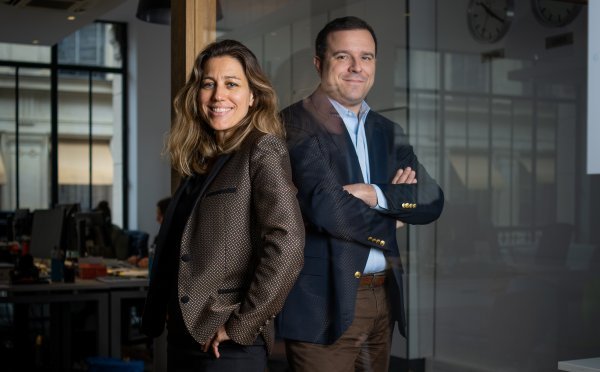
In an increasingly unpredictable world, faced with the challenges of a sustainable economy and the wavering authority of governments, the Internet is an opportunity to build popular trust, a disintermediated link between everyone. But while the network has become omnipresent in our daily lives, the picture of its success is mixed, with fake news, commercial predation and abuse of our data. Aurélie Siou (Cision) asked Edouard Fillias and Caroline Faillet about their vision of influence.
Aurélie Siou (Cision) : What is your definition of influence? What is an influence strategy?
Influence is the ability to provoke a change in opinion or an action in others. For us, influence is inseparable from the notion of trust, because it’s because you trust a voice that you will be influenced by it. Historically, influence was exerted by the public word, rumour, then following the invention of the printing press and public education, the written media greatly amplified the power of influence.But this power remained concentrated in the hands of a handful of powerful people, whether in politics, the media, the intellectual world or the arts… The advent of the smartphone and social networks has turned the traditional mechanism of influence on its head. Today, everyone has a tool in their pocket with the potential to design and broadcast their message to the whole world.
You can inform – and misinform – yourself, film yourself, edit your video and then broadcast it to billions of people on Facebook, Twitter and TikTok, all free of charge and using just a smartphone. With all of us spending so much of our daily lives online, the power to influence has never been so accessible.
This revolution brings its own set of challenges for entities that need to influence in order to prosper, or even survive. Governments, institutions, brands… are all competing with as many issuers as there are users publishing content on social networks. What’s worse, all the surveys show that these public bodies suffer from a lack of public confidence, compared with voices that are considered closer and more authentic, those of the famous “influencers”.
Who are these influencers?
They are people who have mastered social media, whose message has resonated with thousands or even millions of people, and who have built up a community of loyal followers.
Sometimes, the authority figures of the past have managed to build up their status as online influencers: journalists, political decision-makers, managers – many have adopted social platforms to create their own media, bypassing the traditional media filter. But the boundaries are blurring with the new types of influencers, whether they are life coaches, professional video game players, new technology testers, DIY experts… all today enjoy a platform that gives them the ability to reach and influence a vast audience.
From then on, the influence strategy is based on two levers. The first involves engaging in relevant dialogue with communities. The second involves identifying and then activating the influencers we can rely on to relay our messages and achieve our objectives: generating sales, improving our reputation, getting people to sign a petition, obtaining votes, donations, etc. This involves research using advanced technological tools to find influencers whose editorial line, style and audience demographics are compatible with our own. Often, influencer strategy is based on disseminating messages to radically different stakeholders, which means activating different types of channels and influencers.
Influence strategy is successful when it is possible to prove, following the deployment of a campaign, that the messages have indeed provoked the desired changes in opinion and actions. This can be measured both qualitatively and quantitatively, using surveys, or simply by analysing changes in traffic, subscriptions and, of course, sales.
To influence, organisations need to be connected to their communities, both directly and through this network of allies, the influencers.
This is a condition for dialogue, but soon also with the web3 and its new models, to share power with them in a new economy of ownership.
Should we distinguish between organic and monetised influence? Professional” influencers and “product” influencers?
In a society governed by recommendations, companies need to federate authentic allies, over and above paid spokespeople. Often, a complete influencer strategy will combine the two models: influencers from the professional world, also known as B2B, who follow and comment on our brand or organisation with interest, and with whom we nurture long-term relationships. These influencers have a profession and owe their influencer status to their expertise, which is widely recognised on the networks. Paid influencers, on the other hand, see their influencer activity as a way of making a living. This does not prevent them from being selective about the brands and products they decide to promote.
The most credible influencers owe their legitimacy to a certain authenticity built up over the long term with their community, and advertising in spite of their values would be seen as a betrayal of their audience.
Absolutely, it’s one of the challenges of our time. We can see it in the United States, but also with Russian propaganda: veritable empires of harmful influence have been created around the manipulation of facts and the dissemination of false information, the famous fake news. Fake news can sway elections, exacerbate the bipolarity of opinion, and encourage the rise of extremes and conspiracy theories. This negative influence often undermines confidence in science and democratic institutions. It is therefore essential to counter it with a positive influence characterised by transparency, factual rigour, courage and benevolence, in order to restore its social usefulness.
Hence the interest in Web3 and its promise of decentralisation and authenticity.
-
OP-ED | The ethical peril of generative AI
If you haven’t yet tried your hand at verbal jousting with ChatGPT, you’re already one step behind. And, unless you’ve spent the last thirty days in a cave with no internet access, you’ve probably been exposed to experiments in your relationships with ChatGPT all over your LinkedIn newsfeed.
Let’s start with a quick reminder. GPT-3 is a language model, i.e. an artificial intelligence tool designed to produce text. It was launched in 2020. ChatGPT is simply its Chat version, i.e. conversational and with a simplified user experience. You can now interact with this tool and, depending on what you ask it, it will formulate a more or less lengthy or elaborate response.
GPT is generative artificial intelligence. In other words, algorithms that use existing knowledge to generate new content. It’s an absolutely fascinating tool that all of us, professionals and individuals alike, need to learn how to use. But it is so powerful that it raises a number of questions, not least ethical ones.
Those who feared its version 3 are in for a rude awakening. Its new version, GPT-4, will have 100 trillion parameters for analysing and responding to requests. GPT-3 has “only” 175 billion. And for those who want to put the brakes on this innovation, it’s already too late. Meta has designed a “large language model”, OPT-175B. Google presented its LaMDA bot two years ago. We are not to be outdone by Bloom, an AI founded by the French, while China has Wu Dao for its “path of consciousness”, which is around ten times larger than GPT.
AI: From technology to language
Two elements amplify the power of technology: convergence and invisibilisation. They make language models such as GPT and their iterations staggering.
Convergence allows the strengths of several technologies to be combined. Take a digital avatar (GAN), combine it with ChatGPT3, add behavioural neuroscience, offer this avatar an augmented reality (AR) presentation or a video broadcast on a social network such as Instagram, all imagined and delivered by a malicious lobbying company. The result is a convincing, photorealistic expert offering a distorted reading of reality for the purposes of manipulation.
Invisibility, on the other hand, allows technology to be forgotten. It is the result of the miniaturisation and integration of technologies. Imagine the number of services integrated into your iPhone. In the case of our malicious expert, the strategy will be inspired by George Lucas, with the “consensual suspension of disbelief”. In narratology, this means believing that what you are being presented with is real; in epistemology, it means appropriating the truth. To simplify, you tend to forget that the expert in front of you is an artificial intelligence. Take the example of Spike Jonze’s film Her.
When this type of technology interferes in our lives, without it being possible to distinguish between human and machine production, when the public, citizens, consumers or opinion leaders such as journalists, executives or elected representatives, can be fooled by machines, this poses a major problem.
The need for the human hand
I asked the person concerned (ChatGPT) what ethical problems he himself had when it came to communicating on social networks. His answer was honest but short: manipulation of public opinion, discrimination, invasion of privacy, false content. It’s coherent. Criticism of the Languages Models by researchers such as Timnit Gebru and Margaret Mitchell, members of Google’s artificial intelligence ethics laboratory, cost them their jobs…
It is important to understand that within 10 years at most, it will be absolutely impossible to detect what is real and what is artificial in terms of language, photos and video. Only the providers of these services, Big Tech, will be in a position to warn you, in return for payment, of the production of their generative models. Which gives full force to the phrase “truth has a price”. It is also, in politics, an illustration of democratic centralism. According to NewsGuard, ChatGPT relays fake news in 80% of queries on sensitive subjects such as COVID and the war in Ukraine.
Let’s face it: these large language models such as GPT are already capable of instantly analysing a piece of legislation or a document thousands of pages long. They know how to detect objective flaws and then produce thousands of requests (amendments) that will obstruct the debate by creating noise (spam). In other words, we are witnessing the automation of lobbying with a disproportionate volume effect. The aim is to saturate the human or organisational capacity to process information. We know that “information obesity” slows down or even prevents decision-making.
Now imagine this same ‘spam’ approach being applied to all of a government’s or party’s legislation, or to all of a brand’s statements – on Twitter, Instagram, in the press – all at the same time, with the resulting multiplication of ‘spam effects’. You’re suffocating the sender of the messages and blurring the possible understanding of their dialectic. And that’s not to say we don’t have a Cambridge Analytica 2.0 on our hands…
GPT-3 was developed within OpenAI, originally a non-profit organisation created by Elon Musk and investors such as Sam Altman, its current CEO. Today, the non-profit status has changed to for-profit. There is no getting away from the parallels with Arpanet, the university research tool that became the Internet, or the computer ethics of the MIT pioneers. The original ideals have been derailed by the excesses of the commercial Internet (social networks and other abuses of the Dark Web).
Technologies need to be manipulated, in the sense this time of the medieval Latin “to lead by the hand”. It needs to simplify the work of human beings to enable them to move up the value chain. Thinking that it can do the thinking for you, especially when it comes to foresight or progress, is a mistake you should never make. At JIN, we invite all our consultants to use GPT, but we require them to stay in control. We need to keep control of new technologies, but we must never forget that they must remain at the service of people.
-
ARTICLE | Digital: the French malaise
Article published in French in Le Point
A JIN-Opinion Way survey reveals the questions and digital divides that have arisen since the Covid crisis.
This is an indicator that, if left unchecked, could one day become a handicap for French society. Admittedly, the confinement from which we are gradually emerging has led to an acceleration in the use of digital technology in everyday life. has led to an acceleration in the use of digital technology in everyday life, but the study conducted by the digital agency Jin, with the Opinion Way polling institute, and published exclusively by published exclusively by Le Point, makes a number of counter-intuitive observations. While technology has been a great help in times of confinement, notably through the use of teleworking, videoconferencing, online leisure activities and remote shopping, the divides between generations and social categories. “This is the paradox of technology: it is both a factor of resilience and continuity, but also a limit to our freedoms and a factor in our retreat into our original tribe”, notes Édouard Fillias, co-founder of Jin. One of the main challenges we face is to take users by the hand: in France, only 19% of those surveyed feel more at ease with the Internet today than they did at the start of the crisis, compared with 26% in Germany and 34% in the UK. Is there a technological malaise in France? Let’s take a look.
A generational divide…
The first lesson is that Covid-19 has not narrowed the gap between age groups. Indeed, 29% of the under-35s said they were more comfortable using the Internet after confinement, compared with only 16% of their elders. Unsurprisingly, this digital agility decreases with age: 49% of French people under 35 say they have a home meal delivery account, compared with just 9% of those aged 35 and over. Watching films and TV series has also increased much faster among young people (47% of under-35s, compared with 25% of older people), especially in urban areas (40% in Paris, compared with 28% in the rest of France), where it was one of the only leisure activities available.… which nevertheless strengthens family ties
Another surprise of the period that is drawing to a close: the forties are the cause of a return to one’s roots, tending to turn in on oneself, reveals the report. The people surveyed have distanced themselves from most of their circle of acquaintances – their friendship and professional networks in particular – but have drawn closer to their family.More agile craftsmen
When asked about the general impact of technology on their daily lives, low-income respondents income respondents, “whose jobs are potentially more likely to be replaced by artificial potentially more likely to be replaced by artificial intelligence or robotics”, were much more more concerned than more affluent respondents. More surprisingly, 33% of craftsmen, shopkeepers and company directors said they were “more comfortable using the Internet. With the closure of restaurants and shops, many of them have turned to digital turned to digital markets such as Deliveroo or Uber Eats”.
But a growing mistrust of “fake news”
While a large proportion of French people have taken advantage of this period to become better informed, the study notes “an increase in concerns about fake news, privacy and the impact of technology on [their] everyday lives”. In fact, fake news is now a concern for 39% of our fellow citizens. It has to be said that the period now drawing to a close has been full of ‘intoxications’, some of which have had frightening effects, as shown by the links unfairly put forward between 5G and Covid, which resulted in the burning of telephone masts.
Technology, I love you and I love you notIt’s true that the amount of time spent behind screens has exploded via educational platforms or platforms devoted to video games, such as Twitch or Discord, but mistrust is still on the rise, particularly when it comes to the use of personal data. This is of concern to “only” 22% of French people (compared with 33% of Americans), but the issue is growing.”It’s important for users to take ownership of how their data is used”, notes Édouard Fillias, who points out that this new mindset represents a challenge for companies. Few brands are succeeding. In 3 of the 4 countries studied, Amazon is the only one cited positively for its “benevolent” attitude during the crisis, with the exception of… the French.The most popular company in our country is LVMH, even though only 4% of those surveyed were in favour of it.The brand references of the world to come have yet to be created.To do this, we need to convince the younger generation. Because, as the authors of the study point out, the trend in France is the opposite of that in our neighbours: “The younger you are, the more pessimistic you are”.
-
OP-ED | “Becoming an American or even Chinese digital colony? or even Chinese? We must reject this inevitability”.

Op-ed published in French in l’Opinion.
Edouard Fillias and Bruno Retailleau, a French politician: “France must follow the British example and set up a unit within its armed forces to combat digital propaganda”.
Cyber-attacks, data theft and violations of privacy, digital disinformation and political destabilisation through trolls: now nearly 40 years old, the Internet has failed to live up to the promise of its youth, that of a peaceful and unified humanity. Cyberspace meant the end of the superpowers, we prophesied on the threshold of the second millennium. The illusion was short-lived.
To the east, in the land of BATX (Baidu, Alibaba, Tencent, Xiaomi), China is weaving its authoritarian web. In the west, the United States is pulling the strings. As it always does. Between 2005 and 2016, Google will have hired nearly 200 members of the US government, the Senate Committee of Inquiry into Digital Sovereignty. At the same time, around sixty of the web giant’s employees joined the White House, government agencies and other government departments over the same period, joined the White House, government agencies or Congress. In the recesses of the American deep state, the Gafams (Google, Amazon, Facebook, Apple, Microsoft) are keeping a watchful eye. And they are amassing massive amounts of data on Europeans, on our businesses, our government departments and our citizens.
But are we really doomed to become an American or even a Chinese digital colony? We must reject this inevitability. The only battles that are lost in advance are those that are not fought. But all too often in France, the State is fighting the wrong battle when it comes to digital technology. The latest example is the Avia law on online hate. At the same time as proposing to tax them, the government is preparing to give Facebook, Twitter and Google new powers to delete content, in other words to introduce privatised censorship. As well as undermining our freedoms, isn’t this an abandonment of sovereignty?
“The data of our administrations and businesses must be able to be stored in a safe place, out of reach of the public. stored in a safe place, out of reach of foreign servers, in a 100% French and European public cloud”.
Let’s stop giving the Gafams the stick to beat us with and really arm ourselves. Let’s grab the sword and the shield. The shield first, because our data must be protected. Starting with the most sensitive: that of the State, our administrations and our businesses too. They must be stored in a safe place, out of reach of foreign servers, in a 100% French and European public cloud. This is the only way to defeat the Cloud Act, the extraterritorial US law that allows the US justice system to demand our data at any time, even when it is hosted on European soil.
But we must also protect our personal data. Every day, Internet users provide the digital giants with data free of charge, data that the giants used to sell at a premium, and over which we have no control.
In other words, the scandal is twofold: economic and democratic. Internet users must be able to refuse or accept the transfer of their personal data. If they agree, they should be paid by the platforms concerned. France must be the first country to introduce data ownership, as proposed by the Génération Libre think tank.
“Why not set up an AI monitoring agency to measure the quality and transparency of algorithms with a view to it becoming European?”
Furthermore, while public authorities must protect the freedom and property of Internet users, it is also up to them to guarantee the quality of the artificial intelligences they use. As we all know from our regular experience of platforms: all too often, these AIs work not primarily in the interests of their users, but to maximise profits and ‘retain’ customers. Admittedly, it is difficult to control source code, which is too complex and, what’s more, constantly evolving. However, it is entirely feasible to check that artificial intelligences are delivering advice, recommendations and products in line with their commercial promise. Why not set up an AI control agency to measure the quality and transparency of algorithms, with the aim of becoming European? But our country cannot position itself as a key player on the digital stage if it is content with an exclusively defensive strategy. Let’s go on the offensive!
Let’s do it in the face of Gafam, of course. Let’s not just warn about the risks of Libra, the digital currency that Facebook wants to create.
Libra, the digital currency that Facebook wants to create: let’s establish the principle of banning it and think about creating a public cryptocurrency, as proposed by the Senate’s committee of enquiry. Similarly, the French tax on Gafam is unsatisfactory because it will depend on the declarations made by these groups.Being offensive also means resisting attempts to manipulate our opinions and destabilise our institutions by foreign actors who opportunistically use the digital weapon. From the Cambridge analytica affair to jihad 2.0, the facts demonstrate the reality of the threat. The British have become aware of this challenge to the collective security of our democracies. That’s why they have created a unit within their army, the 77 brigade, to win this information war. France must follow their example and, under the supervision of the parliamentary intelligence delegation, set up a unit to combat digital propaganda.
“Let’s focus our investments on our competitive advantages! Thanks to its scientific, mathematical and technical capital, France has everything it takes to become a leader in artificial intelligence and quantum computing”.
Finally, to compete on equal terms in the digital space, we also need to set
strategic priorities. To gain dominant positions, it is always preferable to concentrate forces rather than disperse them. French Tech is undeniably a reservoir of talent and innovation, but without clear priorities, it cannot constitute a real power strategy for France. Let’s focus our investments on our competitive advantages! Thanks to its scientific, mathematical and technical capital, France has everything it needs to become a leader in AI. Similarly, it needs to step up its research and innovation efforts in the next disruptive technology, quantum computing. Our country can also become a spearhead for new virtual imaging technologies, as Dassault Systèmes is already doing.On all these issues, we need to develop alliances with our European partners on the model of enhanced cooperation. Let’s open our eyes: what we are experiencing today, through the rise in tensions between nations and the crisis in post-war international governance, is the return of power. This power is no longer just military or economic; it is now technological. Because cyberspace is both “soft” and “hard” power. As a vehicle for representations, sometimes – unfortunately – conditioning opinions, digital technology is now seen as the pursuit of war by other means, as demonstrated by the development of hacking or the strategies pursued by states or proto-state actors.
For us French, the difficulty lies in the fact that in France the dominant culture among public officials does not lead them towards digital technology, or even towards power, because sovereignty often seems to them to be an outdated idea. But it is not. Sovereignty remains the unsurpassable horizon of politics. Unsurpassable but not immutable. Because the conditions under which it is exercised are changing. Yesterday, the atom was the top strategic priority. Today, it’s the algorithm. But we are still faced with the same challenge: do we still want to retain control of our common destiny? Or do we prefer, out of laziness or weakness, to leave it in other hands? As far as we are concerned, the choice has been made: sovereignty for France and freedom for the French.
-
OP-ED | Gilets jaunes: how to get out of the crisis? What’s next?
Op-ed published in French in Les Echos.
While the barricades have yet to be dismantled, after weeks of staggering events, it’s clear to all that history must be written, and that Emmanuel Macron is an essential, if silent, protagonist. What can he do to emerge from the crisis? And afterwards, what can he do to restore lasting economic and social order?
The solitude of power must never have seemed so burdensome to our new President. We imagine him far from serene, sometimes busy with a noria of advisors and evening visitors with contradictory recommendations, sometimes pensive in front of news channel images, his chair tipped back and tie undone. Now that the barricades have not yet been dismantled, after weeks of shocking events that have seen simple French people rise from the ranks, feeling humiliated, then recognized in the ambiguity of a mobilization that has turned violent, it is clear to all that history must be written, and that Emmanuel Macron is an essential, albeit silent, protagonist.
In order to identify ways out of the crisis, it is necessary to identify its raison d’être. This is an immensely difficult task, given the chaos that surrounds us, but it does perhaps enable us to discern two deep-rooted causes: the failure of the French social and political model.
Causes & consequences
First and foremost, it’s the return of the social question: a sort of 1983, the “liberal turn” of François Mitterrand’s seven-year term, in reverse. While President Macron had focused on a supply-side economy, the beginnings of a rationalization of the SNCF and the ecological transition, she has put the issues of purchasing power, public services and tax pressure back at the heart of her agenda. In the dock, without a doubt, is the figure of the protective State: the implicit agreement between the French, who are keen on public spending, and their State, is the protection of employment and quality of life. At a time when taxes and social security contributions are approaching 52% of GDP – a European record – the quality of public services is steadily declining. The French are clearly not getting value for money. Like all hyper-socialized systems, the welfare state has become a machine for creating exclusion, unemployment and dissatisfaction. The ultimate injustice is that it is the most disadvantaged, the least politically integrated and therefore the most silent, who pay the heaviest price.High levels of income inequality are perfectly acceptable in any society. This is not a political problem, but it becomes one when the hope of upward social mobility disappears completely for certain categories of the population. They are left with an inefficient social and public spending model, low purchasing power and no hope of any improvement for themselves or their children.
It’s also a crisis of representation. The subsequent mobilization of hundreds of thousands of non-politicized French people, gathered on Facebook for want of anything better, bears witness to the complete absence of organizations likely to represent them. Associations, unions, parties, are no longer sufficient to contain the expression of anger, to mediate it and to negotiate a balance of power with the government. The strength and weakness of the Gilets jaunes, their plasticity and multiplicity, make them incapable of building a negotiated political solution. Other movements of this type have preceded them, of varying form and degree, but with very similar modalities of action: the Arab revolts, Anonymous, the Orange or Rose Revolution, the Tea Party…
How to get out of the crisis?
The President has only two serious options for overcoming the institutional crisis, which it is possible to model without lapsing into political fiction. The departure of the Prime Minister or a reshuffle, both of which are unlikely to convince, given the President’s personal exposure. Also ruled out is a dissolution of the National Assembly, which would lead Emmanuel Macron to lose his majority and, ultimately, would not solve his personal equation either. A Machiavellian cohabitation could enable him to create a salutary distance, but given the shortening presidential term and his political DNA of action and results, it is unlikely to serve him well.The first serious political option is the great social shift. Against a reformist, social-democratic or second-left political matrix, the President will do violence to his liberal fiber and release, quickly and intensely, to save his mandate and restore order, a social “gift” package that the French Gilets jaunes won’t be able to refuse. It’s a change of policy translated into concrete and immediate measures. In the short term, at least, it will mean raising pensions, raising the minimum wage and, why not, taking up Xavier Bertrand’s proposal for tax-free bonuses. A major concession would be the reinstatement of the wealth tax (ISF), considered an abscess of fixation. This social package, a denial of a policy based on budgetary conformity, must carry enough weight to act as a definitive extinguisher on the fire that is consuming the country. It will also buy time to pursue other structural reforms that the country needs and on which the President knows he has the support of public opinion, such as the reform of the SNCF’s status.
This may well have been the starting point for a second half of the five-year term oriented to the left, designed to recapture an electorate that had become distant since the President’s assertion of a center-right positioning. For a time, Emmanuel Macron may have thought of himself as the new strongman of the center-right, the virtual successor to Alain Juppé – but that time will now be past.
The second option is the referendum. As an institutional tool par excellence, it can be used to bolster a weakened legitimacy which, in any case, condemns his political room for manoeuvre. A test of power, of course, it must also be a useful response to mobilization, with an object that is intelligible and in touch with people’s concerns. First theme: the constitutional creation of a popular initiative referendum, at various levels, and the necessary digital tools. This is one of the most legible expectations of the Gilets jaunes movement: having spoken out, they no longer intend to return to their previous silence. On the other hand, the establishment of a significant dose of proportional representation in the National Assembly, to better represent the entire political scope.
This second scenario is of course preferable, although it would be difficult to avoid a part of the social package to restore order, while at the same time offering a political perspective: demonstrating through the ballot box that the French social system, based on uncontrolled spending, needs to change.
What’s next?
What’s the incentive to work for someone who receives only a very marginal additional income from work in exchange for subsidies? It’s a question of rebuilding an overly socialized, disempowering system, where individuals are unable to project themselves into the future, and where feelings of insecurity dominate. Contrary to what those in power think, the French Gilets jaunes are well aware of the profound changes taking place in the world and in technology. They know better than anyone that their jobs will be robotized. As Laurent Alexandre points out, AI will “manufacture” Gilets jaunes.The solution proposed by the think tank Génération Libre, Revenu de Liberté (Liber), or basic income, which I prefer to call Allocation Universelle, is a concrete path to economic reintegration. This social “new deal” would rationalize public subsidies while making life paths more secure.
At the risk of breaking certain taboos, we must question our lack of economic sovereignty. The 3% convergence criteria within the euro will be untenable if we are to finance the necessary transformation of our State, while at the same time extracting a drifting section of the population from impoverishment. Paradoxically, reducing the civil service, reorganizing services and optimizing the State will initially be very costly: we’ll need to invest, finance civil service departures, fund our industrial priorities, and massively refinance our abandoned university system. What’s more, it would be unsustainable to obtain productivity gains and rationalize our public services, through efforts that are sometimes painful, without being able to prioritize our national companies when it comes to public procurement. Of course, this has to be a European concertation, which we can see from the British, Italian and Greek examples, is absolutely necessary and sometimes contrary to German orthodoxy.
Finally, the model of individual contribution to public life needs to be reinvented. The French want more control and political initiative. In addition to the necessary digital platforms and citizen referendums, we need to review our trade union model, which has been abandoned by its members. Renovating trade unionism, freeing it up to make it once again essential to social negotiation, means deregulating it.
What are the keys to adapting in a complex environment?
How to respond to the challenges of the energy transition? How can we position ourselves in an unstable economic and political environment? How to make the most of innovation opportunities in every sector? On a daily basis, through our decrypts, surveys, columns, international press reviews and editorials, we support our subscribers by giving them the keys to adapting to a complex environment.

