

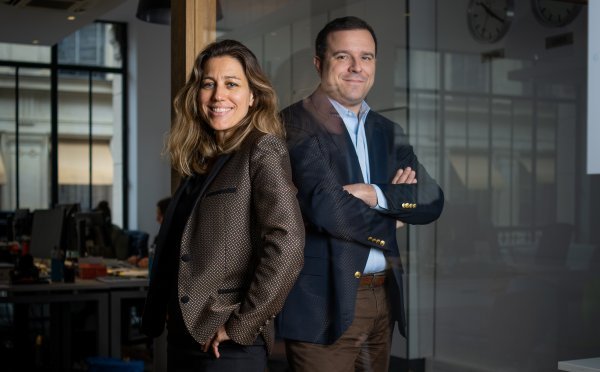
In an increasingly unpredictable world, faced with the challenges of a sustainable economy and the wavering authority of governments, the Internet is an opportunity to build popular trust, a disintermediated link between everyone. But while the network has become omnipresent in our daily lives, the picture of its success is mixed, with fake news, commercial predation and abuse of our data. Aurélie Siou (Cision) asked Edouard Fillias and Caroline Faillet about their vision of influence.
Aurélie Siou (Cision) : What is your definition of influence? What is an influence strategy?
Influence is the ability to provoke a change in opinion or an action in others. For us, influence is inseparable from the notion of trust, because it’s because you trust a voice that you will be influenced by it. Historically, influence was exerted by the public word, rumour, then following the invention of the printing press and public education, the written media greatly amplified the power of influence.
But this power remained concentrated in the hands of a handful of powerful people, whether in politics, the media, the intellectual world or the arts… The advent of the smartphone and social networks has turned the traditional mechanism of influence on its head. Today, everyone has a tool in their pocket with the potential to design and broadcast their message to the whole world.
You can inform – and misinform – yourself, film yourself, edit your video and then broadcast it to billions of people on Facebook, Twitter and TikTok, all free of charge and using just a smartphone. With all of us spending so much of our daily lives online, the power to influence has never been so accessible.
This revolution brings its own set of challenges for entities that need to influence in order to prosper, or even survive. Governments, institutions, brands… are all competing with as many issuers as there are users publishing content on social networks. What’s worse, all the surveys show that these public bodies suffer from a lack of public confidence, compared with voices that are considered closer and more authentic, those of the famous “influencers”.
Who are these influencers?
They are people who have mastered social media, whose message has resonated with thousands or even millions of people, and who have built up a community of loyal followers.
Sometimes, the authority figures of the past have managed to build up their status as online influencers: journalists, political decision-makers, managers – many have adopted social platforms to create their own media, bypassing the traditional media filter. But the boundaries are blurring with the new types of influencers, whether they are life coaches, professional video game players, new technology testers, DIY experts… all today enjoy a platform that gives them the ability to reach and influence a vast audience.
From then on, the influence strategy is based on two levers. The first involves engaging in relevant dialogue with communities. The second involves identifying and then activating the influencers we can rely on to relay our messages and achieve our objectives: generating sales, improving our reputation, getting people to sign a petition, obtaining votes, donations, etc. This involves research using advanced technological tools to find influencers whose editorial line, style and audience demographics are compatible with our own. Often, influencer strategy is based on disseminating messages to radically different stakeholders, which means activating different types of channels and influencers.
Influence strategy is successful when it is possible to prove, following the deployment of a campaign, that the messages have indeed provoked the desired changes in opinion and actions. This can be measured both qualitatively and quantitatively, using surveys, or simply by analysing changes in traffic, subscriptions and, of course, sales.
To influence, organisations need to be connected to their communities, both directly and through this network of allies, the influencers.
This is a condition for dialogue, but soon also with the web3 and its new models, to share power with them in a new economy of ownership.
Should we distinguish between organic and monetised influence? Professional” influencers and “product” influencers?
In a society governed by recommendations, companies need to federate authentic allies, over and above paid spokespeople. Often, a complete influencer strategy will combine the two models: influencers from the professional world, also known as B2B, who follow and comment on our brand or organisation with interest, and with whom we nurture long-term relationships. These influencers have a profession and owe their influencer status to their expertise, which is widely recognised on the networks. Paid influencers, on the other hand, see their influencer activity as a way of making a living. This does not prevent them from being selective about the brands and products they decide to promote.
The most credible influencers owe their legitimacy to a certain authenticity built up over the long term with their community, and advertising in spite of their values would be seen as a betrayal of their audience.
Absolutely, it’s one of the challenges of our time. We can see it in the United States, but also with Russian propaganda: veritable empires of harmful influence have been created around the manipulation of facts and the dissemination of false information, the famous fake news. Fake news can sway elections, exacerbate the bipolarity of opinion, and encourage the rise of extremes and conspiracy theories. This negative influence often undermines confidence in science and democratic institutions. It is therefore essential to counter it with a positive influence characterised by transparency, factual rigour, courage and benevolence, in order to restore its social usefulness.
Hence the interest in Web3 and its promise of decentralisation and authenticity.
 edouardfilliasjin
Leave a comment